UEDIN · 3474
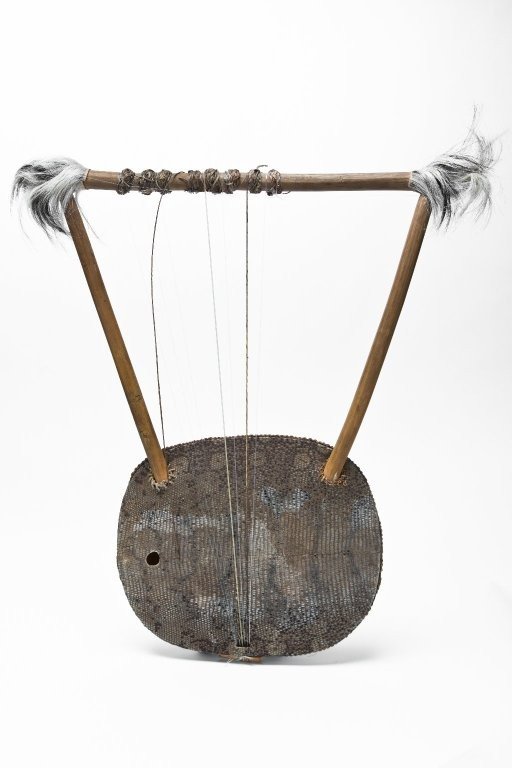
Ntongoli or endongo (bowl lyre).
Zoom with the + and − buttons, a double-click, a pinch, or Ctrl + mouse wheel.
Description
Technical description: Comprised of wooden bowl and yoke with bowl-shaped sound table covered by monitor lizard skin. The arms of the yoke pierce the cover of the sound table, but not the bowl. One small sound hole cut into the skin on the right side of the bowl. Strings of mixed composition: 2 of twisted cattle sinew and 6 of fishing line nylon; all strings attached to yoke with strings of bark-cloth. Tuned pentatonically. Decorative tassels of goat hair affixed to ends of yoke. Alternating bands of different coloured lacing on back of bowl. `diameter' 250-300 mm; yoke length 482 mm. Performance technique: The endongo can be played either sitting or standing. To play while sitting, the performer balances the bowl of the lyre between the legs, tilting the strings to the left. Holding the left arm of the lyre in the left hand, the performer plucks with the nearest three strings with the thumb, middle, and ring fingers. The right hand remains behind the rest of the strings, plucking with the strings of that hand. The little finger of the right hand can either hook around the right arm of the lyre or remain free for greater movement in plucking. The performer can also put a strap around the shoulders and hook it on the instrument, much like a guitar, in order to play the instrument while standing. Among the Ganda, the endongo plays a leading part in larger instrumental ensembles, next to spike tube lutes, a notched flute, and a drum. However, it is primarily used for song accompaniment. Strings are of similar length, tuned in an order to fit the convenience of the player. Historical sources and dispersal: This ntongoli or endongo is a type of lyre that originated with either the Ganda or Soga of Uganda. It belongs to a family of East African bowl lyres located among the Bantu groups that live around Lake Victoria. Early versions of the East African lyre appear with the kingdom of the Kush (c.650 BCE-325 CE) and Aksum (c.100-350 CE).
Measurements
560 perpendicular to yoke.