RCT · RCIN 20717
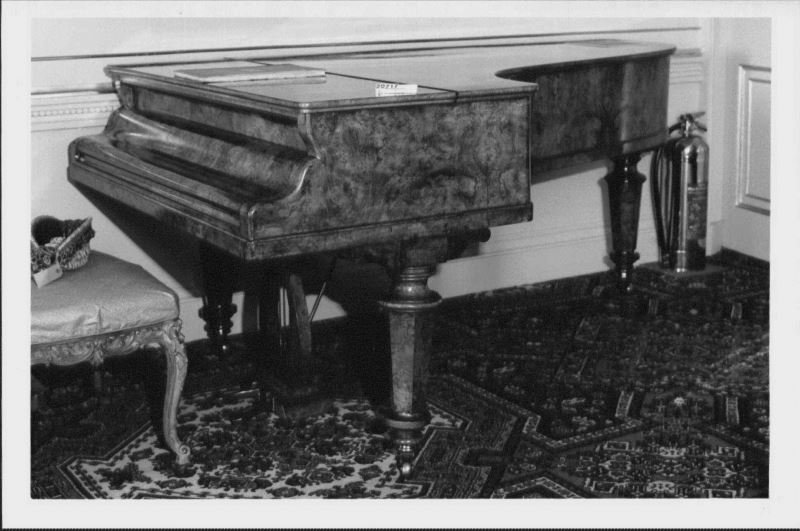
Grand pianoforte
Zoom with the + and − buttons, a double-click, a pinch, or Ctrl + mouse wheel.
Description
Burr-walnut grand piano, the lid with slightly projecting moulded rim, which opens to reveal music stand. Three hexagonal-in-section legs turned at top and bottom. Lyre-shaped support with two pedals. With inscription, 'GREAT EXHIBITION / the only / COUNCIL MEDAL / FOR PIANOFORTES / TO ERARD OF / LONDON. ' Erard was founded by Sébastien Erard (1752-1831). Trained in Strasbourg, Erard moved to Paris in 1768 and began making pianos for the French nobility. He was later joined by his brother Jean-Baptiste Erard (1749-1826) and the business grew, especially after Royal commissions from Marie-Antoinette, but suffered during the French Revolution. The family opened a London outlet in 1790/1, which concentrated on the production of harps. Sébastien is famous for making a great number of technical improvements and inventions and took out between fifteen and twenty patents in England alone. After the death of Sébastien Erard, Jean Baptiste's son Pierre (1794-1855) took over the busines in Paris and London, winning a gold medal at the 1824 Paris Exposition and later becoming piano maker to Albert, Prince Consort. Many illustrious pianists played Erard instruments, including Liszt and Mendelssohn.